Tell us about the job
Takes about a minute. No obligation.
A compressor that sat untouched through fall, winter, and spring is the one a contractor checks before anything else. Homes in Kent County, RI run cooling about two months a year, from July through August. Contactors corrode and capacitors weaken during long idle periods, and neither problem announces itself until the system is called on for the first time in July. The fault was already there. A contractor repairing a unit here looks at startup components first, because that is where the damage from standing off accumulates.
Ductwork that has been patched, adapted, and run through decades of cooling seasons tells a contractor something before they even reach the unit. Half the homes in Kent County, Rhode Island were built in 1967 or earlier (2020-2024 ACS 5-year). A system sitting in a house that age has almost certainly been repaired before, and the parts it takes may have cycled through several rounds of obsolescence. What a contractor opens may need a component that requires sourcing outside standard supply channels, which adds time and changes the shape of the quote. The age of the housing is the reason the equipment inside it has accumulated that kind of history.
The Parts of a Central AC a Contractor Checks First
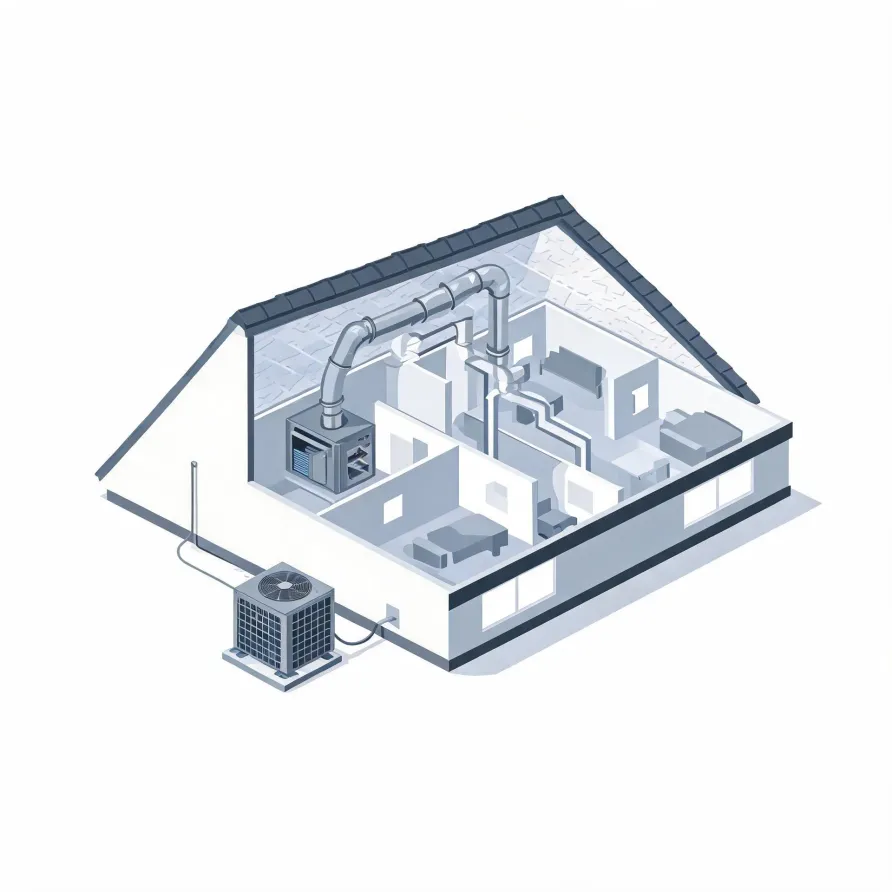
The outdoor condenser unit sits outside the house, usually on a concrete pad beside the foundation, and it is where heat gets shed to the outside air. The compressor lives inside that cabinet and is often where a contractor starts when the system stops cooling. A failed capacitor, a seized compressor, or a refrigerant leak will all show up here first.
Inside the house, the air handler or furnace cabinet holds the evaporator coil, the blower motor, and the filter. The evaporator coil pulls heat from the indoor air, and when it ices over or leaks, the whole system loses its ability to cool. The blower motor pushes conditioned air through the house, so a weak or failed motor means little to no airflow at the registers.
The drawing shows how these pieces fit together in a typical installation, and a licensed contractor determines exactly what applies to your home.
Find a contractor in Kent CountyKent County, by the numbers
146 severe weather events were recorded in Kent County, Rhode Island between 2015 and 2024.
NOAA National Centers for Environmental Information, Storm Events Database, bulk CSV export, events 2015-01-01 through 2024-12-31.Half the homes in Kent County, Rhode Island were built in 1967 or earlier (2020-2024 ACS 5-year).
U.S. Census Bureau, 2020-2024 American Community Survey 5-Year EstimatesKent County, Rhode Island holds 76,529 housing units (2020-2024 ACS 5-year).
U.S. Census Bureau, 2020-2024 American Community Survey 5-Year EstimatesOwners occupy 73.1% of the occupied homes in Kent County, Rhode Island (2020-2024 ACS 5-year).
U.S. Census Bureau, 2020-2024 American Community Survey 5-Year EstimatesCodes & Standards Governing Central AC Repair in Kent County, Rhode Island10 sourced rules and standards
What happens when a contractor comes out for HVAC repair in Kent County
Split-system central air conditioners rated below 45,000 Btu/h manufactured on or after January 1, 2023 must meet a federal minimum of 13.4 SEER2.
Split-system central air conditioners rated at or above 45,000 Btu/h manufactured on or after January 1, 2023 must meet a federal minimum of 13.4 SEER2.
Split-system central air conditioners manufactured between January 1, 2015 and December 31, 2022 had to meet 13 SEER, the metric that preceded SEER2.
Single-package central air conditioners manufactured on or after January 1, 2023 must meet a federal minimum of 13.4 SEER2.
Space-constrained central air conditioners manufactured on or after January 1, 2023 must meet a federal minimum of 11.7 SEER2.
Federal efficiency standards for split-system central air conditioners and heat pumps are set on each certified combination of outdoor unit and indoor coil rather than on the outdoor unit alone.
Residential and light commercial air conditioning and heat pump systems assembled in the field, including mini-splits and unitary systems, may not be installed on or after January 1, 2025 using a refrigerant with a global warming potential above 700.
A field-assembled system whose specified components were all manufactured or imported before January 1, 2025 carries no installation compliance date under the refrigerant restrictions and may still be installed.
Licensing and Legal Requirements in Kent County, Rhode Island
A Rhode Island master licensee needs no separate sheet metal licence while the air handling equipment is ten (10) tons or less, or the heating equipment does not exceed 250,000 BTUs; above either figure the sheet metal work must be subcontracted to a licensed sheet metal contractor.
Rhode Island requires a licence from the Department of Labor and Training to work in the mechanical trades: nobody may hold themselves out as a master, or advertise that they will install refrigeration and air conditioning or air distribution systems, without one.
Severe Weather Events in Kent County
Weather puts real hours on cooling equipment. Every storm cycle that hits Kent County drives thermal swings, power fluctuations, and run-time spikes that add up across a system's life, which is why local repair needs here are shaped by local conditions.
146 severe weather events, 2015–2024. Source: NOAA National Centers for Environmental Information, Storm Events Database.